

 Kenya’s annual inflation reached 6.8% in September 2026, with food and transport among the main pressures on household budgets. What does this mean for ordinary Kenyans?
For many Kenyan households, payday brings a familiar calculation: rent first, food next, transport, school expenses, electricity and whatever remains for emergencies.
For some families, the challenge is not simply earning more money. It is trying to stretch an income across essential expenses that continue to put pressure on household budgets.
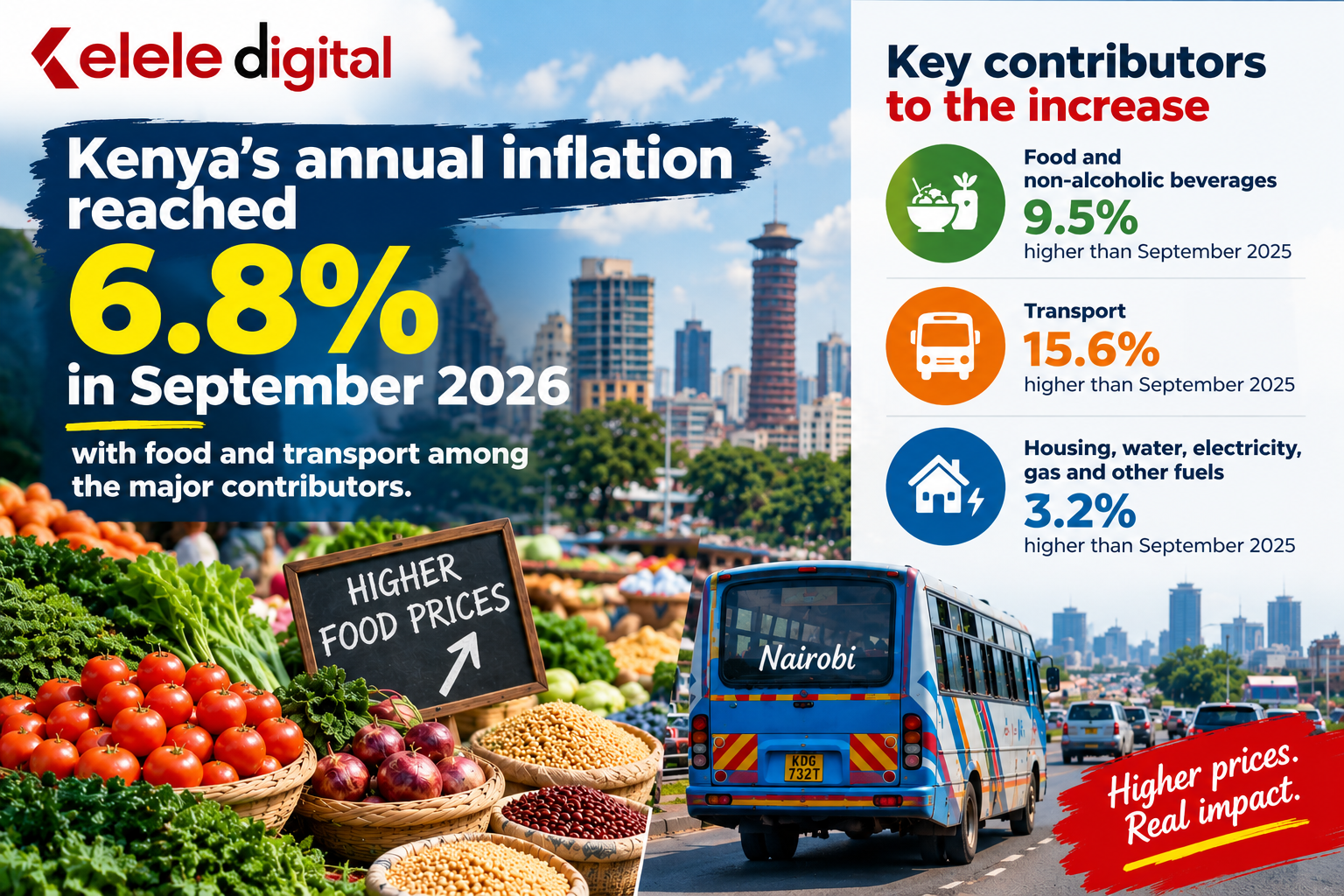
The latest available consumer price data from the Kenya National Bureau of Statistics (KNBS) offers an indication of the challenge. Annual consumer price inflation reached 6.8% in September 2026, up from 6.6% in August.
Food and non-alcoholic beverages, transport, and housing-related costs were among the categories contributing to the overall increase.
For consumers, these figures raise an important question: what does the rising cost of living mean for the money Kenyans take home every month?
What the inflation figures tell us
According to KNBS, annual inflation in September 2026 was driven in part by price increases in three major expenditure categories:
- Food and non-alcoholic beverages: Prices were 9.5% higher than in September 2025.
- Transport: Prices were 15.6% higher than in September 2025.
- Housing, water, electricity, gas and other fuels: Prices were 3.2% higher than in September 2025.
These are year-on-year changes, not increases experienced by every household in exactly the same way.
Inflation measures changes in the general price level across a basket of goods and services. Individual households may experience different pressures depending on where they live, how they travel, what they eat and how they spend their income.
Nevertheless, the figures highlight why essential expenses remain an important concern for consumers.
Food: The daily cost that cannot be avoided
Food is one of the most immediate ways households experience changes in prices.
Families may respond by buying smaller quantities, changing meal plans, choosing different products or shopping at alternative markets. Such adjustments can help manage a limited budget, but they may also reduce dietary variety or leave families with fewer choices.
Small businesses are affected too. Food vendors, restaurants and retailers must balance the cost of purchasing supplies with what customers can afford to pay.
When consumers reduce spending, businesses may experience lower sales even as their own operating expenses remain high.
The result is a difficult cycle for both households and traders.
Transport: The cost of getting to work
Transport expenses affect more than people who own cars.
Workers who use matatus, buses and motorcycles, as well as small traders who move goods between suppliers and customers, can feel the impact of higher transport costs.
For someone travelling to work every day, even a modest increase in the cost of each journey can add up over a month.
Transport expenses can also influence where people seek employment, which schools families can afford and whether small businesses can reach customers beyond their immediate neighbourhoods.
The relationship between transport and household finances is therefore wider than the price of fuel alone.
Housing and utility bills
Rent, electricity, water, cooking fuel and other household necessities compete for the same limited income.
When several essential expenses rise or remain high at the same time, families may have less money available for savings, healthcare, education and unexpected emergencies.
Young people entering the workforce can face particular pressure when they must pay rent and transport costs while supporting relatives or repaying education-related expenses.
For households already living close to their financial limits, an unexpected bill can force difficult decisions about which expenses to delay.
What can households do?
Individual budgeting cannot solve the underlying causes of inflation, but it can help families understand where their money goes and identify manageable adjustments.
Plan around actual spending. Track essential expenses over a month instead of relying on estimates. Separate fixed costs such as rent from variable costs such as food and transport.
Compare prices carefully. Where practical, compare prices across shops and markets. Consider value, quality and quantity rather than choosing products on price alone.
Plan meals and shopping. A weekly meal plan can help reduce waste and unnecessary purchases while making food spending more predictable.
Review transport choices. Where safe and practical, compare routes, travel options and opportunities to coordinate journeys.
Be cautious with borrowing. Avoid taking expensive loans to cover recurring expenses without a realistic repayment plan.
Build savings when possible. Even small, consistent contributions can help create a buffer against unexpected expenses, although saving may not be feasible for every household.
These steps can help with financial planning, but responsibility for the cost of living does not rest on consumers alone.
What should policymakers consider?
Addressing the cost of living requires attention to the factors that influence the supply and price of essential goods and services.
This includes food production and distribution, transport infrastructure, energy costs, competition in markets and the economic conditions affecting household incomes.
Policy proposals intended to reduce taxes or lower prices should be assessed against their actual effects, implementation costs and the extent to which benefits reach consumers.
For example, a reduction in a particular tax does not automatically guarantee that retail prices will fall by the same amount. The final impact depends on how the measure is implemented and how businesses respond.
Reliable data, transparent policy decisions and regular monitoring are therefore essential.
The bigger question: Are incomes keeping pace?
Inflation describes how prices change, but household wellbeing also depends on income.
A person whose earnings rise more slowly than the cost of essential goods may find that their purchasing power declines. Someone whose income remains unchanged can face an even greater squeeze.
That is why discussions about the cost of living should consider both prices and wages, alongside access to stable employment and affordable essential services.
For households, the challenge is immediate. For policymakers and employers, the task is to find sustainable ways to improve purchasing power and economic security.
The September figures do not tell the complete story of every Kenyan family. They do, however, provide a measurable starting point for a conversation about what people pay, what they earn and what needs to change.
Kelele Digital asks: Which expense is putting the greatest pressure on your household budget right now: food, rent, transport, school fees or utilities? What practical changes would make the biggest difference?
Share your experience and join the conversation.
Data source: Kenya National Bureau of Statistics, Consumer Price Indices and Inflation Rates — September 2026. Inflation rates represent national price changes and may not reflect the exact experience of every household.
#KeleleDigital #CostOfLiving #KenyaEconomy #Inflation #HouseholdBudget #Kenya


