

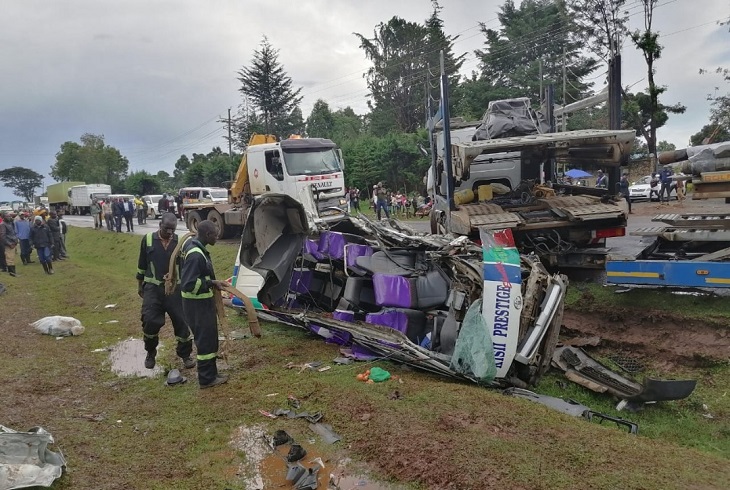
Another journey has ended in tragedy. Kenya’s roads continue to claim lives, raising questions about dangerous driving, accident black spots and the effectiveness of safety interventions.
Read the full story on Kelele Digital and join the conversation.
Kenya’s rising road fatalities demand safer highways, responsible driving, stronger enforcement and urgent action at accident black spots.
Every journey should end with a safe arrival. Yet for many Kenyan families, travelling on the country’s roads has become a source of fear, particularly following a series of fatal crashes in October.
The latest concerns have been intensified by a deadly collision involving a passenger bus and a lorry near Kanga, in Makueni County, along the Nairobi–Mombasa Highway on 25 October 2026.
The crash renewed scrutiny of one of the country’s busiest transport corridors, where passenger buses, trucks, private vehicles and public service vehicles share sections of road that have repeatedly been identified as dangerous.
The tragedy is a reminder that road safety cannot be reduced to occasional traffic crackdowns. It requires sustained action from drivers, transport operators, road authorities, law enforcement agencies and passengers.
The numbers behind the tragedy
According to reporting by the Daily Nation, at least 41 people died in three major crashes on the Nairobi–Mombasa Highway between 23 September and 25 October 2026.
Separately, the National Transport and Safety Authority (NTSA) recorded 3,995 road deaths nationally between 1 January and 4 October 2026. The authority’s figures also indicated a rise compared with the same period in 2025.
These figures cover different periods and reporting scopes, but both point to the scale of the road-safety challenge.
Behind every statistic is a person: a parent, a child, a worker, a student or someone travelling to visit family. Road deaths also leave survivors facing injuries, medical expenses, emotional trauma and financial uncertainty.
Why do fatal crashes keep happening?
Road crashes often result from several contributing factors rather than a single cause.
Speeding, dangerous overtaking, driver fatigue, impaired driving, unroadworthy vehicles and failure to observe traffic rules can increase the risk of a collision. Road design, poor visibility, inadequate separation between opposing traffic and delays in emergency care can also affect the severity of an accident.
The Nairobi–Mombasa Highway illustrates some of these challenges. Certain stretches have been identified as accident black spots, and the transition between dual and single carriageways can expose motorists to greater risks.
Investigators must establish the causes of individual crashes before responsibility is assigned. However, repeated accidents at known dangerous locations should prompt authorities to assess whether additional safety measures are needed.
Are enforcement measures enough?
NTSA has announced intensified enforcement ahead of the festive travel season, targeting dangerous driving, speeding, driver fatigue and vehicle compliance.
Such measures are important, but enforcement must be consistent. Drivers and operators should not expect safety rules to apply only when traffic officers are present.
Public service vehicle operators have a particular responsibility to ensure that their vehicles are roadworthy, their drivers properly licensed and their schedules allow sufficient rest. Passengers should also feel able to raise concerns about dangerous driving without being ignored.
At the same time, authorities responsible for roads must assess infrastructure risks and implement appropriate engineering interventions where necessary.
What can be done to make Kenyan roads safer?
Several practical measures deserve sustained attention:
1. Address known accident black spots. Authorities should assess dangerous sections, implement appropriate engineering improvements and communicate progress to the public.
2. Enforce traffic laws consistently. Speeding, dangerous overtaking, overloading and impaired driving should attract appropriate consequences regardless of the driver’s status.
3. Improve driver fatigue management. Long-distance operators should plan realistic journeys, provide adequate rest and avoid schedules that encourage dangerous driving.
4. Strengthen vehicle inspections. Defective brakes, tyres, lights and other safety-critical components should be identified before vehicles carry passengers or goods.
5. Improve emergency response. Timely rescue, accessible emergency medical services and coordinated response systems can help reduce the consequences of serious crashes.
6. Make road users part of the solution. Pedestrians, cyclists, motorcyclists, passengers and motorists all need safer environments and a stronger culture of road responsibility.
Road safety is a shared responsibility
It would be unfair to blame every crash on drivers alone when infrastructure and other factors may also contribute. Equally, poor roads cannot excuse reckless behaviour.
The challenge is to investigate each incident properly, establish the contributing factors and take corrective action.
For families who have lost loved ones, promises of future action cannot undo the damage. But effective measures can help prevent other families from experiencing the same loss.
Kenya needs road-safety interventions that continue after headlines fade and that can be measured by whether deaths and serious injuries decline.
Kelele Digital asks: What is the most urgent road-safety intervention Kenya should prioritise: fixing accident black spots, stricter enforcement, better driver training or improved emergency response?
Share your views, and always choose safety over speed.
Sources: National Transport and Safety Authority reporting and Daily Nation coverage of recent Nairobi–Mombasa Highway crashes. Figures are attributed to their respective reporting periods.
#KeleleDigital #RoadSafety #NTSA #RoadAccidents #UsalamaBarabarani #Kenya


